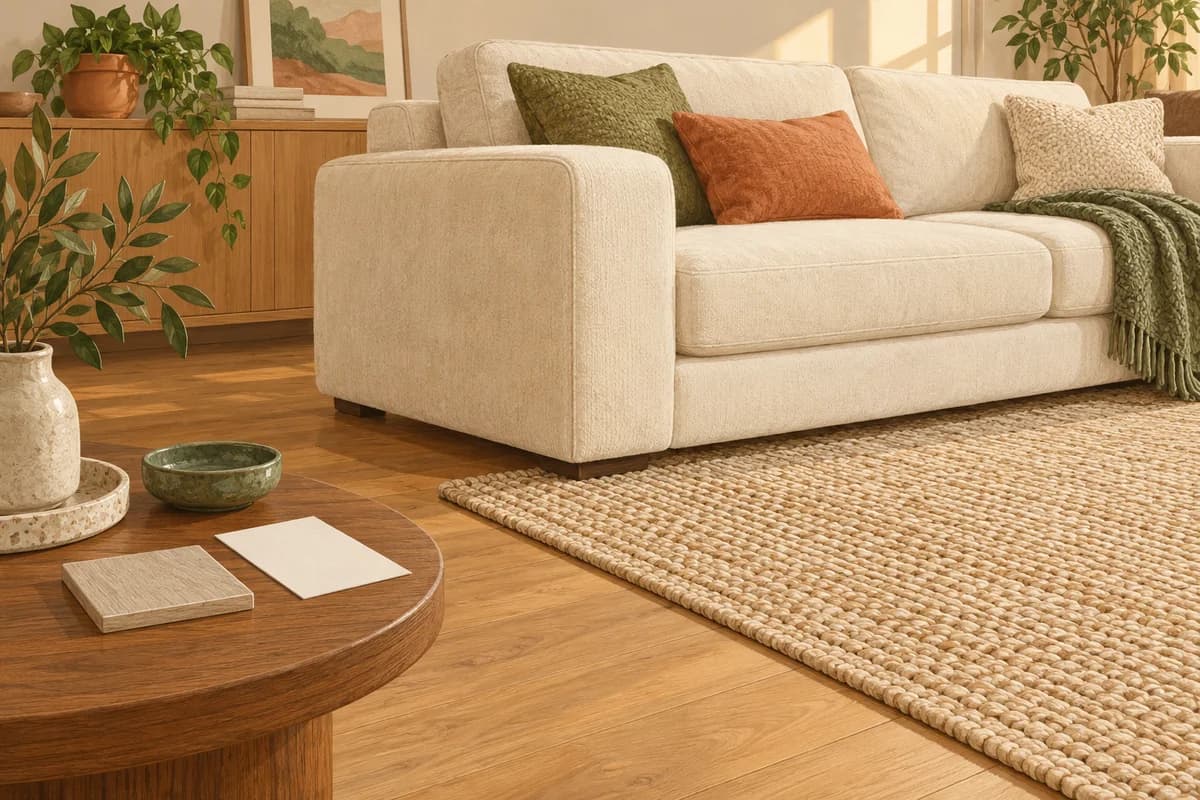
Does the front-legs-on-rug rule apply to every sofa?
No. First establish whether the exact sofa stands on identifiable feet, a wider base or another documented contact arrangement. The upholstered outline seen from above is not necessarily the area touching the floor. For a broad contact area, a rug edge can cross underneath it in a way that a front-leg illustration does not describe. IKEA's rug guide suggests putting the front legs of a sofa and armchair on the rug to connect the furniture visually. Treat that as a styling option. It does not identify a BoxSofa underside or approve a layered surface for it. Obtain an underside diagram or identified photograph from the seller; do not turn over or dismantle furniture contrary to its instructions.
Should the sofa be fully on, partly on or beside the rug?
Compare those as three different placements rather than assuming one is always best. Draw the rug boundary over the sofa's documented contact map. For a full placement, check that every contact area you intend to include lies within it. For a partial placement, note precisely which feet or base areas meet each layer. For a separate rug, record the gap between the rug edge and sofa. An edge drawn across an unidentified underside is a question to resolve, not a completed plan. You can move the rug boundary on paper or compare another size. Do not add folded fabric or improvised pads to compensate for a height difference. The drawing records geometry; it does not establish stability, grip or an approved support arrangement.
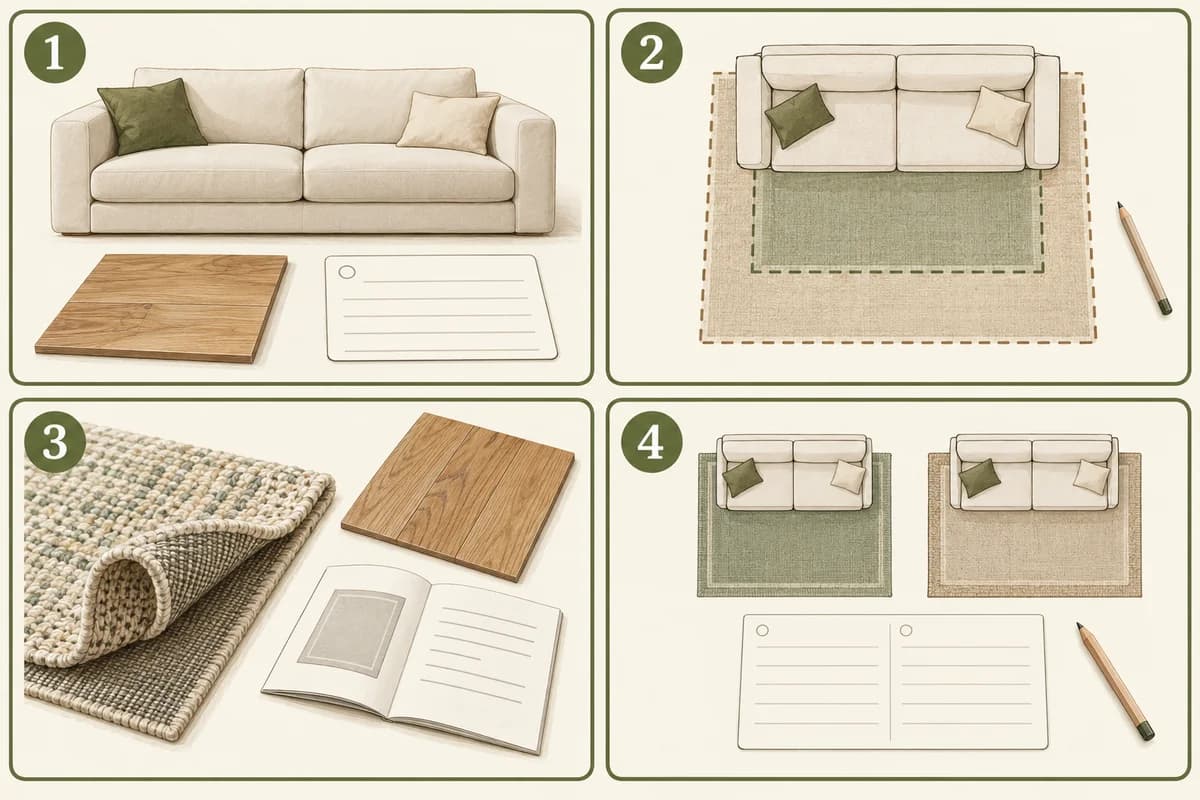
How can you compare rug sizes without guessing from a photo?
Use the finished sofa outline and the rug's stated dimensions in the same orientation. As a hypothetical calculation, a 95 × 95 cm square footprint centred on a 240 × 170 cm rectangle leaves (240 − 95) ÷ 2 = 72.5 cm at each end of the 240 cm dimension and (170 − 95) ÷ 2 = 37.5 cm at each end of the 170 cm dimension. Moving the footprint changes those margins. This is an arithmetic example, not a recommended rug size or measured product arrangement. Chameleon (Mario) BS-CHAMELEONMARIOSOFA-01 lists a finished size of 95 × 95 × 70 cm; confirm the dimension order and contact areas separately. With an irregular rug, use its actual outline rather than only the largest width and length. Check walking space with the separate sofa–table guide.
Which rug thickness and edge details matter?
Record the whole proposed stack: rug construction, pile, backing, edge binding and any separate underlay. Pile height alone may not describe total thickness. Note where each layer ends, especially if the rug edge or a smaller underlay would fall beneath a sofa contact area. Ask the rug supplier what the published thickness measures. A photograph cannot tell you how a pile behaves beneath the exact sofa, and this guide sets no universal maximum thickness. Compare the arrangement with the sofa and rug instructions before choosing. If they do not address partial placement over an edge, obtain clarification or revise the boundary. A thinner-looking rug is not, by itself, evidence that the combination is suitable.
Can any anti-slip underlay go on any floor?
No. Identify the floor product or finish and check the actual backing and underlay materials against its instructions. The words anti-slip describe a claimed function; they do not list every compatible flooring surface. If you are keeping an existing rug, locate its label and identify any separate layer already underneath it. Floor & Decor's vinyl-floor FAQ advises against rubber- or latex-backed rugs because of possible staining or discolouration. That is a concrete reason to check materials, not a conclusion about every floor or every BoxSofa model. Do not transfer vinyl guidance to wood, laminate or tile without their relevant instructions. For an unidentified floor, seek the product record or clarification from its supplier before selecting an additional layer.
What changes with a sofa made from several pieces?
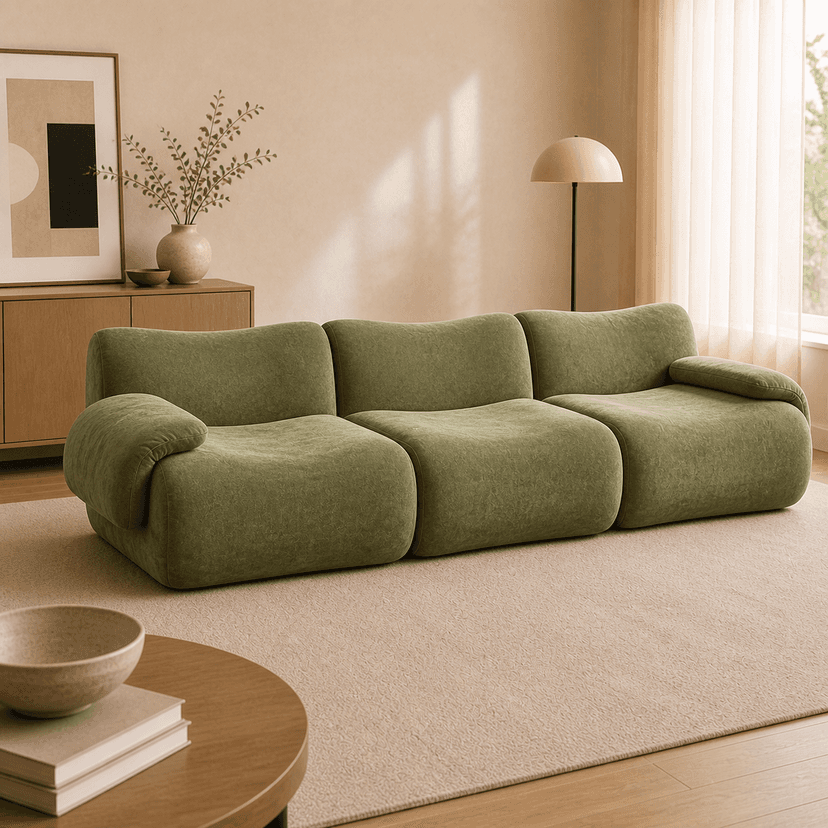
Map the contact areas for every piece in the exact documented arrangement. One rug may reach beneath one part but stop underneath another; changing the arrangement can move an edge relative to those contacts. Keep a separate sketch for each configuration you are actually permitted to use. A modular description alone does not establish that every piece can move independently. Remy BS-REMYSOFA-04 lists an approximate finished size of 290 × 100 × 64 cm and describes a two-arm double seat plus an armless single seat. Those are published catalogue facts, not underside specifications. Neither this listing nor the Chameleon example establishes rug compatibility or anti-slip performance. Use the module-direction guide for configuration questions, then assess the rug for that confirmed arrangement.
Can you still reach the rug and floor for routine care?
Plan how the covered surfaces will be reached using the furniture's handling instructions. Record whether cleaning the rug edge or accessing the floor would require moving the whole sofa or a permitted separate piece, and where the rug would go during its own care. A placement that looks convenient may make an existing cleaning routine difficult. Use the relevant care instructions for each surface, including any requirements before replacing a cleaned rug. Do not assume that the sofa cover's washing instructions also apply to its underside or the rug. Avoid adding adhesive products or extra layers without checking their intended use and compatibility. There is no invented inspection interval here: retain the actual instructions with the worksheet and revise the care plan when the arrangement changes.
What four steps lead to a useful buying decision?
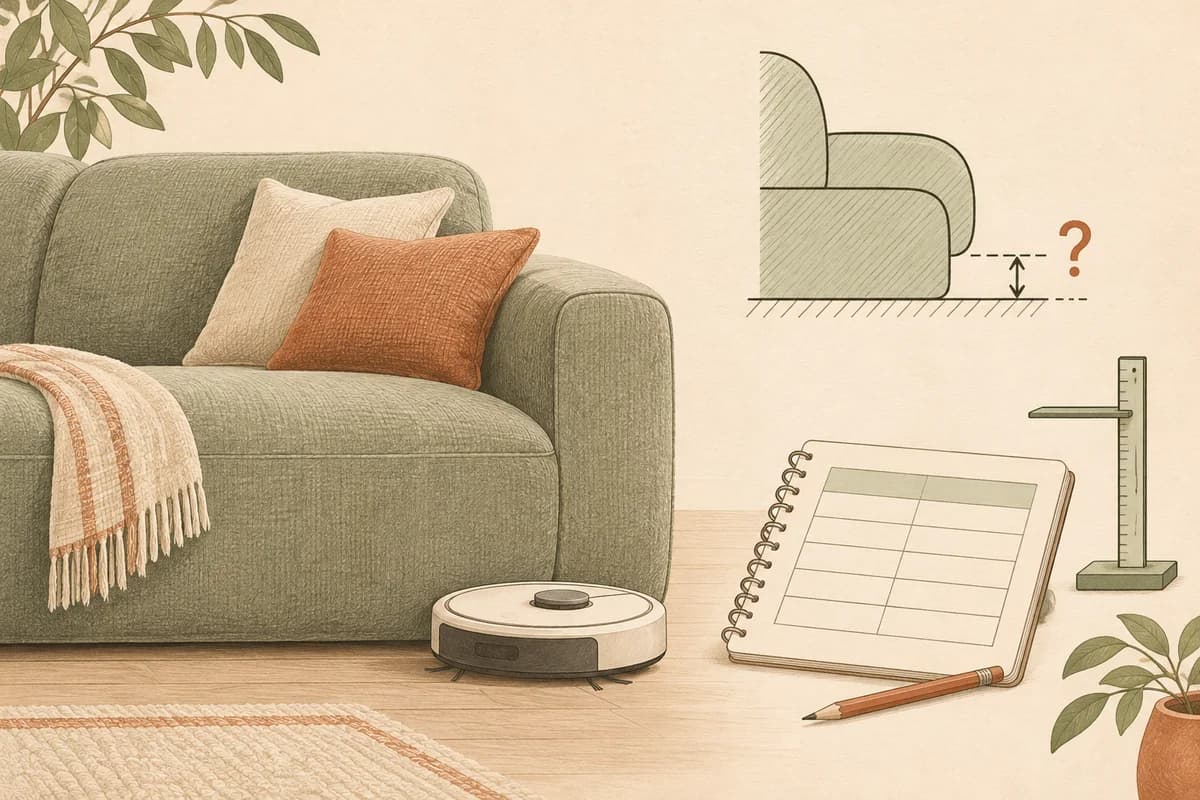
First identify the exact sofa and floor. Second draw the outer outline, documented contacts and rug boundary. Third compare the rug, backing and underlay information with all relevant instructions. Fourth compare alternatives and record how you will reach the surfaces for care. Keep one completed worksheet per combination so a new rug size or arrangement does not inherit an earlier decision. Choose when the evidence supports your intended placement; revise or defer where materials or contact details conflict or remain essential and unresolved. The two images are generic AI editorial illustrations, not product photographs, scale drawings, physical tests or proof of grip or floor protection. Sources checked on 26 October 2026. Original editorial worksheet. BoxSofa Europe Editorial Team, with AI-assisted editing · 26 October 2026.
| What to record | Your proposed combination | Evidence / decision |
|---|---|---|
| Exact sofa, variant and documented arrangement | ____ | Product reference / date ____ |
| Finished outline and actual floor contacts | Outline ____ × ____ cm; feet / base ____ | Diagram / seller confirmation ____ |
| Flooring product and surface finish | Brand / range ____; finish ____ | Relevant care instructions ____ |
| Rug dimensions and edge position | ____ × ____ cm; edge crosses ____ | Sketch / measurement ____ |
| Rug pile, total thickness, backing and edge binding | ____; ____ mm; materials ____ | Rug label / supplier ____ |
| Separate rug underlay, if proposed | Reference ____; thickness ____; materials ____ | Compatibility and placement instructions ____ |
| Alternative placement and access for cleaning | All on / partly on / separate ____; access ____ | Conflicts / changes ____ |
| Purchase decision and remaining evidence | Keep / revise / defer ____ | Who confirms ____; date ____ |
A practical checklist before you decide
- Identify the exact sofa, its underside and the flooring product or finish.
- Draw the finished sofa outline, actual contact areas and proposed rug edges.
- Record rug thickness, backing and any underlay; compare all applicable instructions.
- Compare placements, plan access for care and resolve material or placement conflicts before buying.
Sources and applicable terms
General planning guidance, not a physical product or access test. The chosen variant's measurements and instructions take precedence. Terms can change; check them before payment.
- Chameleon (Mario) single seat — BS-CHAMELEONMARIOSOFA-01
- Remy three-seat — BS-REMYSOFA-04
- Modular sofa direction and permitted arrangements
- Sofa and coffee table: check the walking space
- IKEA: Choosing the right rug — visual placement guidance
- Floor & Decor: Can I use rubber-backed rugs on my vinyl floors?